


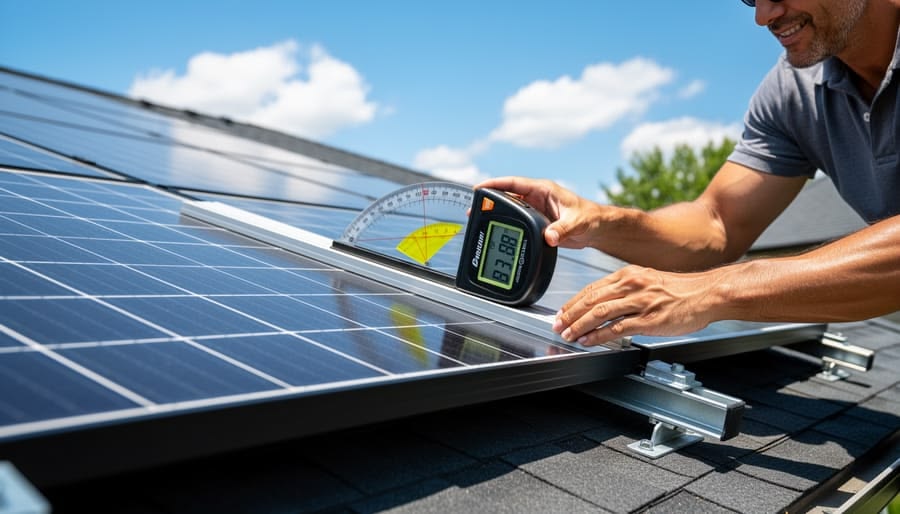

Installing solar panels is an effective way to generate renewable electricity for homes, offices, commercial buildings, and other properties. However, simply installing solar panels on a roof does not guarantee maximum energy production. The solar panel tilt angle in Kerala plays an important role in determining how effectively panels receive sunlight throughout the year.
Kerala has a tropical climate, with strong sunlight during many months and significant seasonal changes caused by the monsoon. Because of these conditions, proper panel positioning, roof orientation, shading, and tilt angle should be considered when planning a solar power system.
This guide explains how solar panel tilt angle works, what factors influence the ideal angle in Kerala, and what homeowners should consider before installation.
The solar panel tilt angle is the angle at which a solar panel is positioned relative to the horizontal surface of the roof or ground.
Solar panels generate electricity when photovoltaic cells absorb sunlight. The amount of sunlight reaching the panel can vary depending on the position of the sun and the angle of the panel.
When sunlight reaches the panel more directly, the panel can generally receive more solar energy. Therefore, selecting an appropriate tilt angle can help improve the overall performance of a solar installation.
The ideal angle is not necessarily the same everywhere. Latitude, roof structure, seasonal sunlight, shading, panel orientation, and the purpose of the solar system can all influence the final installation angle.
Kerala is located relatively close to the equator compared with many regions farther north or south. This means the sun can reach high elevations in the sky during parts of the year.
For this reason, solar panels installed in Kerala generally do not require the steep angles commonly used in higher-latitude locations.
A properly selected solar panel tilt angle in Kerala can help:
However, tilt angle should not be considered independently. The direction the panels face and the amount of shade received by the panels are also important.
There is no single tilt angle that is perfect for every property in Kerala.
A commonly considered starting range for fixed rooftop solar installations in Kerala is approximately 10° to 15°, depending on the location, roof design, system requirements, and installation objectives.
The exact angle should be determined by a qualified solar installer after considering the property's location and roof characteristics.
For example, a flat concrete roof provides greater flexibility because mounting structures can be used to establish a desired tilt. A sloped roof, on the other hand, may already have an angle that is suitable for the installation.
The objective should not simply be to achieve a particular number. The installation should balance solar exposure, structural requirements, wind conditions, drainage, maintenance, and overall system design.
Tilt angle is only one part of solar panel positioning. Solar panel orientation in Kerala is also important.
For a fixed solar installation in the Northern Hemisphere, panels are generally oriented toward the south to receive strong overall solar exposure across the year. However, the actual optimum can vary depending on the property's location, roof configuration, shading, energy consumption pattern, and system design.
A professional installer can assess the site and determine an appropriate orientation rather than relying only on a general rule.
If a roof has obstructions or limited usable space, panels may need to be positioned differently. In such situations, avoiding significant shading can sometimes be more important than achieving a theoretical optimum orientation.
Kerala experiences different weather conditions throughout the year. The monsoon season can bring prolonged periods of cloud cover and rainfall, while other periods may provide strong sunlight.
Solar panels can still generate electricity during cloudy conditions, although energy production is generally lower when sunlight intensity is reduced.
The tilt angle can also assist with rainwater drainage. A suitable slope allows rainwater to move across the panel surface rather than remaining on the panel.
However, rain should not be considered a replacement for regular solar panel cleaning. Dust, bird droppings, leaves, and other deposits can accumulate on the surface and reduce the amount of sunlight reaching the photovoltaic cells.
The type of roof can have a significant effect on solar panel installation.
Flat concrete roofs are common in residential and commercial properties. They allow installers to use mounting structures to create an appropriate tilt angle.
Before installation, the roof should be checked for structural suitability, available space, drainage, and potential shading.
A sloped roof may already provide a natural angle for solar panels. Installers can assess whether the existing slope is suitable or whether additional mounting adjustments are required.
The roof's direction is also important because two roofs with the same slope can receive different amounts of sunlight depending on their orientation.
Large commercial rooftops may require detailed planning because panels must be arranged to maximize usable roof space while maintaining appropriate spacing and minimizing shading.
Maintenance access and safe installation practices should also be considered.
Even with a carefully selected tilt angle, shading can reduce solar power generation.
Trees, neighboring buildings, water tanks, antennas, walls, and other rooftop structures can cast shadows on solar panels.
Before installing a solar system, a site assessment should identify potential shading throughout the day.
For example, a panel that receives strong sunlight in the morning but is heavily shaded during the afternoon may produce less electricity than expected.
Therefore, solar panel shading analysis in Kerala can be a useful part of the planning process, particularly in densely built residential areas.
Several mistakes can affect the performance of a rooftop solar system.
Choosing a particular angle without considering orientation, shading, roof structure, and local conditions can lead to an inefficient installation.
Even a small amount of shading can affect the output of a solar array, depending on the system configuration and equipment used.
Panels installed too close together may create shading problems, particularly when mounting structures raise panels above a flat roof.
Solar mounting structures should not interfere with existing roof drainage. Kerala's heavy rainfall makes proper water flow particularly important.
A visually neat installation is useful, but performance, safety, accessibility, structural integrity, and maintenance should remain important considerations.
No. A higher tilt angle does not automatically mean greater solar generation.
The ideal position depends on the relationship between the panel surface and the sun's position. Increasing the angle beyond what is appropriate for the location can reduce the amount of sunlight received at certain times of the year.
In Kerala, where the sun reaches relatively high elevations, extremely steep panel angles are generally unnecessary for typical fixed rooftop systems.
Instead of choosing an angle based on assumptions, installers should evaluate the site and system requirements.
Correct panel positioning can also make maintenance easier.
A suitable tilt helps rainwater run off the surface, but regular inspection is still necessary. Solar panels should be checked periodically for dirt, leaves, bird droppings, physical damage, loose connections, and other issues.
The surrounding area should also be inspected for new sources of shade. For example, a tree that was previously small may grow tall enough to cast shadows over the panels.
Keeping the panels clean and unobstructed helps the system operate closer to its expected performance.
Professional solar installation involves more than placing panels on the roof.
A site assessment may consider:
Using these factors, an installer can develop a solar layout that balances energy generation and practical installation requirements.
Choosing the correct solar panel tilt angle in Kerala is an important part of designing an efficient rooftop solar system. A commonly considered starting range for fixed installations is around 10° to 15°, but the exact angle should be determined according to the property's location, roof design, orientation, shading conditions, and system requirements.
Tilt angle should also be considered alongside panel direction, roof structure, spacing, drainage, and maintenance.
For homeowners and businesses planning solar installation in Kerala, a professional site assessment can help determine the most suitable panel positioning for the property.
By combining appropriate tilt, orientation, shading management, quality equipment, and regular maintenance, a rooftop solar system can make better use of the available sunlight and support reliable renewable electricity generation.
Looking for smart technology and energy solutions? Explore Techtify for more information about modern technology solutions and services.

