


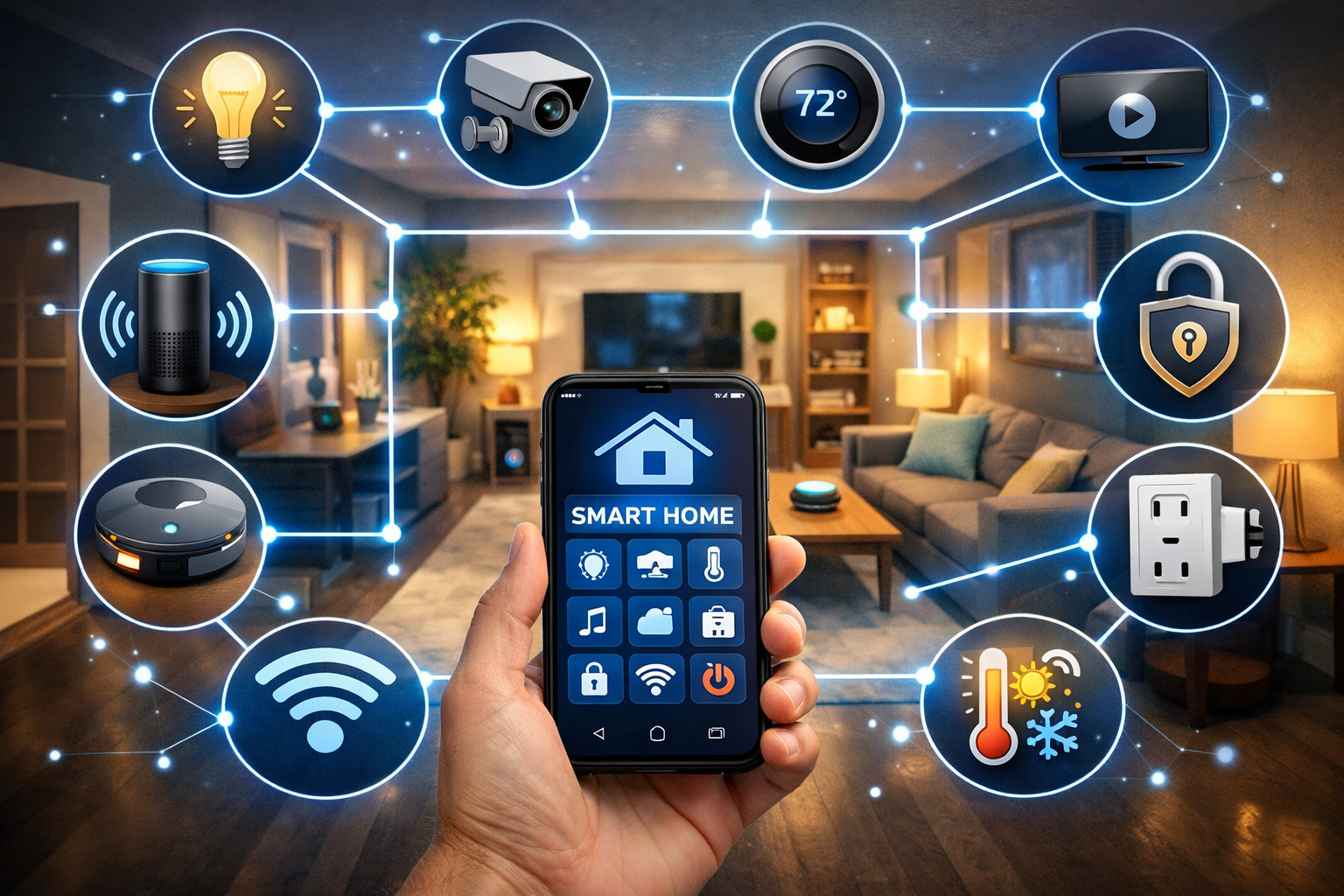

Technology is evolving faster than ever, and our homes are no longer just places to live — they are becoming intelligent ecosystems. From AI assistants that learn your habits to predictive security systems that protect your home automatically, home automation powered by artificial intelligence is transforming everyday life.
The future of living is smart, connected, energy-efficient, and deeply personalized. In this blog, we explore how AI is revolutionizing home automation, the latest trends in smart homes, and what the future holds for homeowners in India and across the world.
Home automation is the use of technology to control and automate household systems such as lighting, security, appliances, temperature, entertainment, and more. These systems are connected through the Internet of Things (IoT) and controlled using smartphones, voice assistants, or AI automation platforms.
In simple words:
Home automation turns your house into a smart, responsive living space.
Today, smart homes can:
The smart home market is growing rapidly due to increased connectivity, affordable devices, and strong demand for energy efficiency and security.
Traditional automation followed fixed schedules. For example, lights turned on at 6 PM every day. But AI brings something revolutionary: predictive intelligence.
Modern smart homes don’t just follow commands — they learn, predict, and act automatically.
AI systems now analyze:
This allows smart homes to anticipate needs instead of waiting for instructions.
Imagine your home:
This is no longer science fiction — it’s happening today.
One of the biggest smart home trends is predictive automation. AI can analyze your daily routine and automatically optimize your home environment.
Examples include:
AI can even detect unusual appliance behaviour and alert homeowners early, preventing expensive repairs.
This means your home becomes self-learning and self-improving over time.
Voice assistants have evolved from simple command tools to generative AI companions.
Modern AI assistants can now:
Generative AI is turning voice assistants into digital home managers.
Instead of saying “Turn off lights,” you can say:
“I’m going to sleep.”
Your home will automatically:
This is the power of AI-driven ecosystems.
Security is one of the biggest reasons homeowners adopt automation.
Modern AI security systems include:
AI improves security by reducing false alarms and detecting threats faster.
New technologies even use Wi-Fi signals to detect motion without physical sensors — making smart homes safer and easier to install.
Smart homes now protect families 24/7, even when they are miles away.
Electricity costs are rising globally. AI is helping homeowners reduce bills with smart energy management.
AI systems analyze energy consumption and automatically optimize usage.
Smart energy features include:
AI can automatically dim lights or adjust appliances based on electricity pricing and routine, saving hundreds every year.
This makes smart homes eco-friendly and cost-efficient.
The next generation of appliances is intelligent.
AI appliances can now:
Appliances are no longer tools — they are smart assistants.
The future kitchen and living space will run itself.
Smart lighting is evolving rapidly.
Modern AI lighting systems can:
New lighting technologies use AI to create personalized environments that improve wellbeing and comfort.
Lighting is becoming part of health and lifestyle design.
Privacy concerns are growing as smart homes become more advanced.
Many new systems now focus on:
Offline AI reduces latency, energy usage, and privacy risks.
The future smart home will be fast, private, and secure.
India is witnessing massive growth in smart home adoption.
Reasons include:
Smart homes are no longer luxury — they are becoming mainstream.
Companies like Techtify are helping bring advanced home automation solutions to Indian households with integrated systems, solar solutions, and surveillance technology.
This is helping homeowners enjoy modern living with convenience and security.
Control your entire home from a smartphone or voice command.
Reduce electricity consumption and save money.
Monitor your home anytime, anywhere.
Create personalized living experiences.
Smart homes have higher real estate value.
IoT (Internet of Things) connects devices into one ecosystem.
Connected devices include:
IoT creates a centralized smart home ecosystem.
By 2030, homes will be fully intelligent ecosystems.
Future innovations may include:
AI detecting mood and adjusting lighting, music, and ambience.
Homes will detect faults before breakdowns.
AI tracking sleep, air quality, and health patterns.
Homes managing cleaning, cooking, and energy automatically.
Homes connected to smart city infrastructure.
The home of the future will be a living digital assistant.
DIY smart devices are common, but professional automation offers:
Professional solutions ensure seamless and scalable smart homes.
Companies like Techtify specialize in:
This ensures homeowners get a complete, future-ready solution.
Despite rapid growth, smart homes face challenges:
However, technology is evolving to solve these challenges quickly.
Smart homes play a major role in sustainability.
They help reduce:
Smart homes support green living and eco-friendly lifestyles.
The modern home is transforming into:
Smart homes save time, reduce stress, and improve lifestyle quality.
The shift toward AI automation is inevitable.
Home automation is no longer a luxury — it is becoming a necessity for modern living.
Artificial intelligence is making homes:
The future of living is connected, intelligent, and automated.
If you are planning to upgrade your home, now is the perfect time to explore professional smart home solutions with experts like Techtify and step into the future of smart living.